
Camera inspection: $300–$750
The first and non-negotiable step. Most operators credit it against the works if you proceed.
Relining turns a recurring drainage problem into a finished one. The joints that roots come through are sealed along the whole run, so there is no way back in, and nothing above the pipe gets disturbed to do it.
The failure that brings most people here is not a broken pipe. It is a joint. Older drainage is laid in short lengths, so a single run has a great many joints, and after decades of ground movement and root pressure they open a fraction at a time until something backs up.
A liner seals all of them in one pass, which is why it changes the pattern rather than resetting it. Cutting roots out clears the pipe and leaves the way in exactly as it was, and the interval to the next blockage is set by how fast they grow back.

A crack that opens in summer and closes in winter produces a fault that comes and goes, which is maddening to diagnose and very easy to dismiss as bad luck.
Soft, moisture-heavy soil near the river shifts through wet and dry spells, cracking joints and pulling pipes out of alignment.
A liner is continuous through the affected length, so seasonal movement no longer has a joint to work on. On reactive ground that is the difference between a repair that lasts and one that reappears the next dry summer.
Concord West’s many Federation-era homes still run old earthenware pipe that cracks and shifts with age, a leading cause of recurring blockages here.
On a period property the drainage repair is rarely the expensive part. Tessellated verandah tiles, original brick paving, a mature garden or a heritage-listed frontage all cost far more to reinstate than the pipe underneath costs to fix.
That is the argument for trenchless in one sentence. The liner is drawn through an existing opening and cured in place, so the surface above is never disturbed and there is nothing to match, replace or explain to council.
Excavation close to the foreshore brings problems that have nothing to do with plumbing: unstable saturated ground, dewatering, restricted access down a narrow lot, and reinstatement of landscaping that was not cheap to build.
The trenchless comparison is not repair against repair. It is repair against repair plus everything sitting on top, and on a waterfront block that second half is usually the bigger number.
An open joint leaks in both directions. On a low-lying block that means stormwater and groundwater entering the sewer through cracks, which is called infiltration, and it quietly overloads a line that would otherwise cope.
Sitting close to the Parramatta River and Bicentennial Park, Concord West’s low ground drains slowly, so heavy rain backs up through overloaded pits.
It shows up as a system that backs up in wet weather and behaves perfectly in dry. If that is the pattern, sealing the run is the fix, and no amount of clearing will reproduce the result.
Clay is rigid, round and predictable, and that geometry is exactly what a liner wants. The resin sleeve cures hard against a barrel that holds its shape, and the short pipe lengths that make clay joint-heavy are the same joints the liner seals in one pass.
So the material that causes the most recurring blockages in older streets is also the easiest to repair properly without digging. That is a genuinely lucky combination and it is why relining suits this housing stock so well.
A listing does not stop you repairing a drain. What it restricts is change that is visible or that disturbs significant fabric, which is precisely what a trenchless repair avoids.
In practice that makes relining the path of least resistance on a listed or conservation-area property: nothing is removed, nothing changes above ground, and there is no reinstatement to get approved.
The first and non-negotiable step. Most operators credit it against the works if you proceed.
Domestic sewer across Sydney in 2026. Longer single runs sit at the lower end of it.
Seals one defect. Right where the rest of the run is sound and the ground is stable.
Length, diameter and how many branches need reinstating are what move the number inside that band.
Excavation is only half the cost. Replacing the driveway or garden above it is the other half.
Figures reflect the 2026 Sydney market rather than a quote. You get your own number once we have seen inside the pipe. Figures here are indicative of the 2026 Sydney market rather than a quote from us, you get your own number as a fixed price before any work starts.

A CCTV survey establishes the material, the diameter, where the defects are and how far they sit from the access. You see the footage, and it is what the quote is built from.
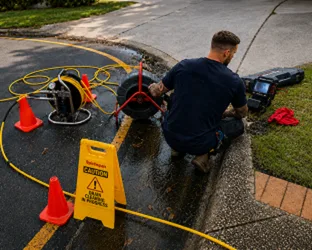
Patch or full length, and occasionally excavation instead. We will tell you when digging is the better answer even though it is the bigger quote.
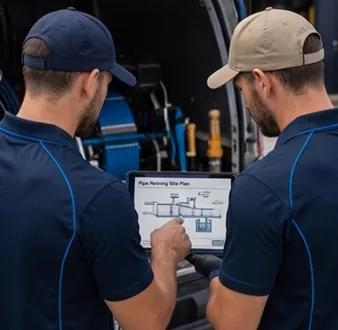
The run is jetted so the liner bonds to pipe rather than debris, the liner is installed through the existing access, and it cures in place. Most domestic jobs are a single day.

Every branch the liner passed is reopened from inside, then the run is cameraed again so you can see it is continuous and the junctions are clear.
Describe what the drain is doing and how often. We will tell you whether it sounds structural or whether a clean and a maintenance interval is the honest answer.
The questions that come up before every relining job, answered with real numbers.

Phone is quickest. The form reaches the crew covering Concord West, and the first step is always the survey.

Leave your details and our local Concord West team will call you back fast.